Analysis paralysis and the myths of being data driven and successful
Do you ever overthink or overanalyze to the point where you stop making decisions and taking action? Where you’re afraid that the choice you’re about to make isn’t the “best choice“, so you wait it out a little more, and maybe research a little more, and maybe gather together more data … just so you can be “sure“? That’s called analysis paralysis.
Debunking the myths of being data driven and being successful can set you free.
What is analysis paralysis?
Analysis Paralysis is that cycle of overthinking/overanalyzing and collecting more data in the hopes that a definitive solution will magically emerge. It’s easy to get here. A lot of the rhetoric around data, decision making, and being successful can lead us to conflate data possession with crystal ball style knowing and confidence.
At its worst, analysis paralysis can bring you to the point where you stop collecting any data at all, because you’re so afraid of the paralysis cycle that you start to avoid it all together in favor of “trusting your gut” or, worse, choosing not to do anything at all.
So let’s unpack some of that rhetoric, debunk the myths, and get real about who has the power.
Data “driven” is a misdirect
Data is clues. Collecting more of it will never make you omniscient or omnipotent. The best you can do is be assisted or informed by data. You have to suck it up and own that you’re the driver of your own fate. You have the power; data can’t tell you what to do.
To believe otherwise is to place data as some omnipresent, omniscient, and omnipotent being. It’s not.
But wait. Where does data come from? Will big data solve my problems?
Datasets, those clues you rely on, are merely simplified representations of a pretty complex world. That means that, just in choosing what you think you need to pay attention to, that is, what data to collect, you’ve already tossed to the wayside a bunch of data/clues that you think are irrelevant. (You were probably right to do so – don’t run off to start collecting even more data just yet!)
“Big data,” like the stuff collected by social media platforms, doesn’t “know” everything either. It seems like it’s omnipresent – always there – and omniscient – how does it know you want pizza? – but it’s also relying on simplified representations and has a lot of gaps. (I say more about this in the next section, using an example of YouTube audience data for the Blou Designs YouTube channel.)
Want an example that uses USDA and CDC data to illustrate how being driven by data can go awry? An example that showcases how we use simplified representations all of the time? Check out this video.
Data isn’t information
Data is clues. (I can’t say that enough.) As such, it’s up to you to interpret them, decide if they’re applicable to the current context, and give them a meaning relative to that context. That’s you exercising your power.
Here’s that example I promised about YouTube audience data for the Blou Designs YouTube channel:
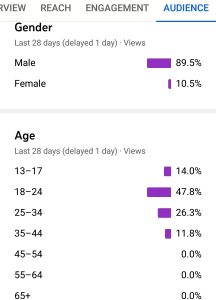


If I took it at face value, I’d “learn” that my viewer demographic is overwhelmingly male (we’ll ignore the fact that male and female are sex categories, not gender, and just roll with this as a gender classification), and that no one aged 45+ checks out my channel.
The problem is that I know for a fact that some typical-client older guys are watching these videos. Some have even subscribed to the YouTube channel. So…where are they in this data? There are a couple of explanations.
The first and most obvious is that my typical clients aren’t as likely to have shared their demographic data as part of their Google profiles, so they’re just not counted here. They also might not be logged in when they view, thereby really not sharing their profile info with this dataset.
The second explanation is that aggregated data frequently won’t show data for groups smaller than a certain number. Why not? It’s part of anonymity and statistical significance. So maybe there aren’t enough of them. Maybe there are also so few that rounding means that they become 0.0% instead of the teeny percentage that they are.
So, when I ask if my videos are “working,” it would be a misstep for me to rely on this type of data as if it contains the whole story.
And this is a perfect example of what I mean when I say data isn’t information, and that it’s up to humans (you!) to interpret and attribute meaning, and figure out how all of that meaning (and your confidence that you got the meaning “right”) fits into your business goals.
Want an everyday example that has nothing to do with business or technology? This short video uses a cereal box example:
Sidetracked by milestone “success”?
A big part of figuring out what to do is listening to what other people have to say. That’s cool. You don’t know everything you need to know, and sometimes you don’t even know what you don’t know. You need other people to help you out, especially when it comes to figuring out how to interpret the data and get the information you need to make a decision.
The trick is to stay focused on your own end goal. That great advice from other people, coupled with the mountain of stuff you need to get done every day, can get you into a place where you start focusing on vanity metrics and milestones (e.g., number of subscribers, how much money you made this month) instead of whether those little successes are getting you closer to your end goal. They’re indicators of whether you’re on track to meet your goal, not goals themselves.
It’s like that old saying about “you can’t see the forest for the trees.” The forest is your big picture goal, and the trees are your indicators. Unfortunately, a lot of the talk about being successful is focused on those trees instead of the forests. And just like that, you’re sidetracked!
How do you keep the forest in the forefront of your mind? Work backwards from the goal, and pick the milestones that make sense. You care about subscribers not for the sake of subscribers, but because of what you think that means in the context of achieving your end goal; you also don’t want to start focusing all of your energy into just growing your subscriber base, because that’s just a step to somewhere else. Is it possible you’ll chose the “wrong” milestones for where you want to go? Yes. The key is to get comfortable with experimentation, tweaking, and, most importantly, completely tossing something that you tried that didn’t work at all. And get comfortable asking yourself questions like, Holistically, what am I trying to do here?
Here’s a short video that hints at how milestones like fundraising targets and number of views add up to your big picture vision and success:
Got “enough” data?
We’ve unpacked the rhetoric. It’s time to end the cycle. Maybe you don’t have enough data, and it’s not analysis paralysis at all. Maybe you’ve got enough to talk it through with someone. Maybe (gasp!) you’re ready to try something.
Watch this video for a less-than-one-minute decision path you can try out to assess your own “enough”:
What’s your takeaway?
If you’ve been “stuck” or “afraid” or “overwhelmed” … Are you hung up on a milestone instead of the end goal? Are you waiting for a perfect view of the entire path, when all we can ever really hope for is a series of conversations and experiments that, in hindsight, help us define a repeatable and/or successful process? Are you not sure how to start your experiment?
Reach out to me if you want to talk it through.
Need some incentive to keep you on track? Tell the world what your next step is! I frequently find that telling other people my plans is enough to motivate me to start delivering results.
And don’t forget to share this with anyone else who needs it!